AI-Officer as a Service
Use AI in mid-sized companies without compliance risk. Pryvet takes on the AI Officer role from a single source, with a platform and certified expertise.
Pryvet provides the external AI Officer
Pryvet provides the external AI Officer for mid-sized companies — comparable to an external data protection officer, but for the full scope of the EU AI Act, ISO/IEC 42001, and the GDPR interfaces. From the first AI use case through risk assessment to audit evidence. Supported by the Pryvet AI compliance platform.
- Full assumption of the AI Officer role – Pryvet fills the function of the AI Officer under Art. 4 of the EU AI Act — including use case recording, risk assessment, documentation, and communication with authorities.
- Software-supported compliance – The Pryvet AI compliance platform provides a use case register, classification wizard, measures tracker, and audit reports from a single interface. Every step is documented in an audit-ready manner.
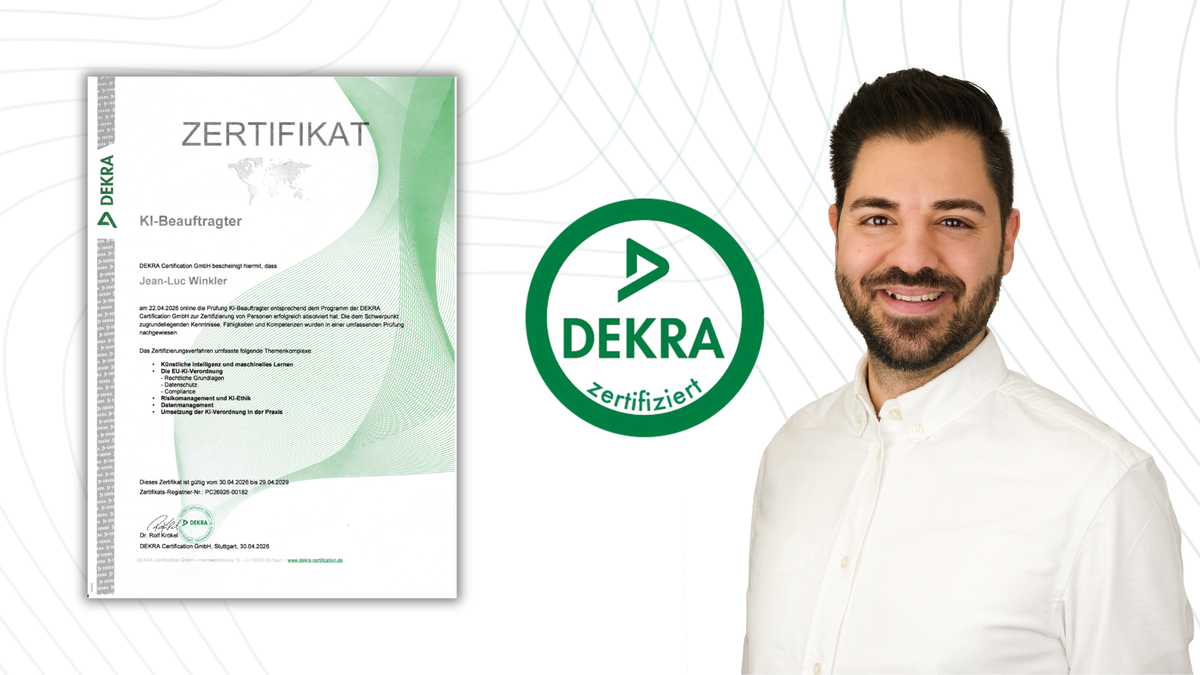
- Double-certified – Pryvet’s expertise is externally confirmed by the TÜV SÜD certificate as AI Coordinator and the DEKRA certificate as AI Officer. Both trainings are recertified on an ongoing basis.
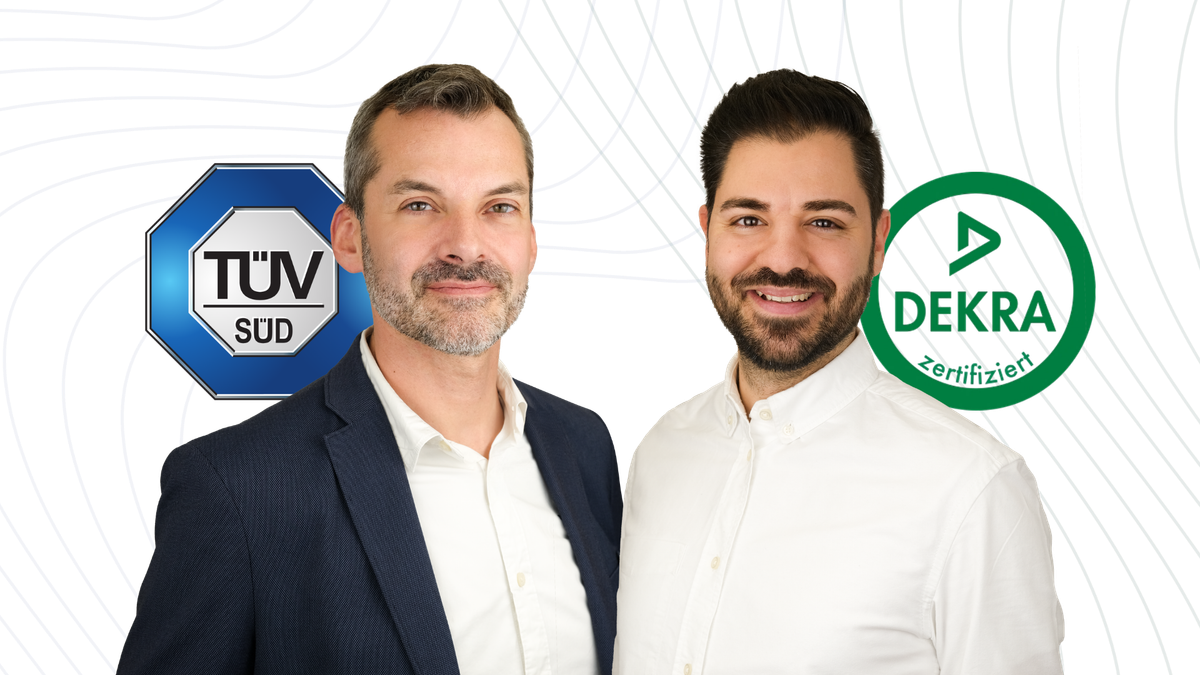
- TÜV SÜD-certified AI Coordinator – proven methodology from the AI Quality Framework (AIQ)
- DEKRA-certified AI Officer – recognized qualification under Art. 4 of the EU AI Act
- ISO/IEC 42001 as the guiding standard – international standard for AI management systems
- AI compliance platform included – no additional tool investment required
- In-house DPO experience – GDPR and the EU AI Act are considered together
AI has long since arrived in mid-sized companies - and unfortunately, so have the obligations.
The AI Officer as an external service — professional, methodical, platform-supported. Microsoft Copilot in the HR department. ChatGPT for quote calculation. A chatbot on the website. Applicant scoring in recruiting. Most companies with 50 to 500 employees already have between five and fifteen AI applications in productive use - often without management having a complete overview.
Under the EU AI Act (EU 2024/1689), the first obligations have applied since February 2, 2025 - in particular the prohibition of certain practices under Art. 5 and the AI literacy obligation under Art. 4. From August 2, 2026, the general penalty provisions apply; the high-risk obligations under Annex III also take effect from that date. The range of fines is tiered: up to €35 million or 7% of worldwide annual turnover for violations of the prohibition under Art. 5, up to €15 million or 3% for violations of the other provider and deployer obligations, and up to €7.5 million or 1% for incorrect or misleading information provided to supervisory authorities (Art. 99 EU AI Act). In addition, there are the ongoing requirements of GDPR Art. 22, 32, and 35, the co-determination obligations under the German Works Constitution Act (BetrVG) §§ 80, 87, 90, 95, and sector-specific regulations such as DORA, NIS-2, or the MDR.
For mid-sized companies, a dedicated full-time AI Officer is rarely economical. A certified external one, however, is - provided they bring methodology, a platform, and industry experience.
The AI Officer as an external service - professional, methodical, platform-supported.
Pryvet provides the AI Officer as an external function. The model has been established for decades — with the external data protection officer. Pryvet transfers it to the EU AI Act and combines it with a compliance platform that digitizes recording, assessment, and evidence end to end.
Pryvet thus takes on two tasks at once: on the one hand, the strategic development of AI potential (use case identification, maturity assessment, roadmap). On the other hand, full regulatory safeguarding (EU AI Act, GDPR, ISO/IEC 42001, sector-specific requirements). Both from a single source, without interface friction between consulting and tool provider.

One service that covers the full regulatory framework.
AI compliance is not a single law but a dense web of EU regulations, German special legislation, international standards and industry-specific requirements. Pryvet works on the basis of all of the following frameworks and keeps them continuously up to date — including the ongoing amendments introduced by the Digital Omnibus on AI.
Regulation & law
Norms & standards
International & ethical frameworks
Industries & interfaces
- EU AI Act (EU 2024/1689) — complete, Art. 1 to Art. 99, Annexes I to XIII
- GDPR — Art. 4, 5, 6, 9, 13, 14, 22, 30, 32, 33, 34, 35, 36, 39, 44 et seq.
- BDSG (German Federal Data Protection Act) — in particular § 26 employee data protection
- BetrVG (German Works Constitution Act) — §§ 80, 87, 90, 95 (co-determination)
- GoBD — AI-related record-keeping obligations
- Sector-specific law — MDR (Medical Devices), DORA (financial sector), NIS-2, KRITIS Regulation
- Digital Omnibus on AI — ongoing amendment of the EU AI Act including SME/SMC relief
- ISO/IEC 42001 — AI Management System (lead standard)
- ISO/IEC 23894 — AI Risk Management
- ISO 31000 — Risk Management Framework
- ISO/IEC 27001 — Information Security Management
- ISO 19011 — Auditing Management Systems
- prEN 18286 — harmonized standard for the EU AI Act (in development)
- AI Quality Framework (AIQ) — TÜV Süd
- NIST AI Risk Management Framework (AI RMF 1.0)
- OECD AI Principles
- Hiroshima AI Code of Conduct
- EU Ethics Guidelines for Trustworthy AI
- BSI / NCSC Guidelines for Secure AI System Development
- UNESCO Recommendation on the Ethics of AI
- HR & recruiting — applicant scoring, employee monitoring, EU AI Act HR tools guideline
- Healthcare & pharma — MDR interface, medical confidentiality
- Finance & insurance — DORA, MaRisk, BAIT/VAIT
- Industry & mechanical engineering — product liability, Machinery Regulation
- Public sector — Art. 6 (3) GDPR, administrative procedures
- Copyright & data law — text and data mining exception, training data licenses
How Pryvet works
Initial consultation & scoping (free of charge)
In 30 minutes, management and Pryvet clarify the scope: industry, number of employees, known AI applications, obligations (provider, deployer, hybrid role), regulatory drivers. Output: an initial indication of effort and risk hotspots.
Gap analysis & assessment of the current state
Pryvet conducts structured interviews with business units, IT, data protection and the works council. Existing AI systems are inventoried (including shadow AI), and the regulatory baseline is measured against the AI Quality Framework (AIQ) and ISO/IEC 42001. Output: a maturity report with the current level for each compliance domain and a prioritized list of measures.
Use case derivation & potential workshop
From the business unit interviews, Pryvet derives concrete AI use cases — starting with quick wins (low risk class, high leverage). Each use case is documented as a profile and undergoes initial classification under Art. 6 of the EU AI Act. Output: a prioritized use case roadmap covering 6, 12 and 24 months.
Appointment as AI Officer & platform onboarding
Pryvet is officially appointed as the external AI Officer — comparable to appointing an external data protection officer. The AI compliance platform is configured with the client's master data (industry profile, number of employees, revenue — relevant for SME/SMC relief under the Digital Omnibus). Output: an active AI Officer, a ready-to-use platform, defined escalation paths.
Ongoing operations
Pryvet runs the function: use case triage, risk assessments, DPIA/FRIA, measure tracking, supplier due diligence, training management, incident management, communication with authorities and the works council. Monthly touchpoint with management, quarterly management summary from the platform.
Audit & continuous improvement
Support for annual internal audits in accordance with ISO 19011 / ISO/IEC 42001 clause 9.2. Preparation for external audits (TÜV, DEKRA, notified body for high-risk providers). Re-audit triggers in the event of an incident, a legal update or a significant system change. Output: audit report, management summary, updated roadmap.
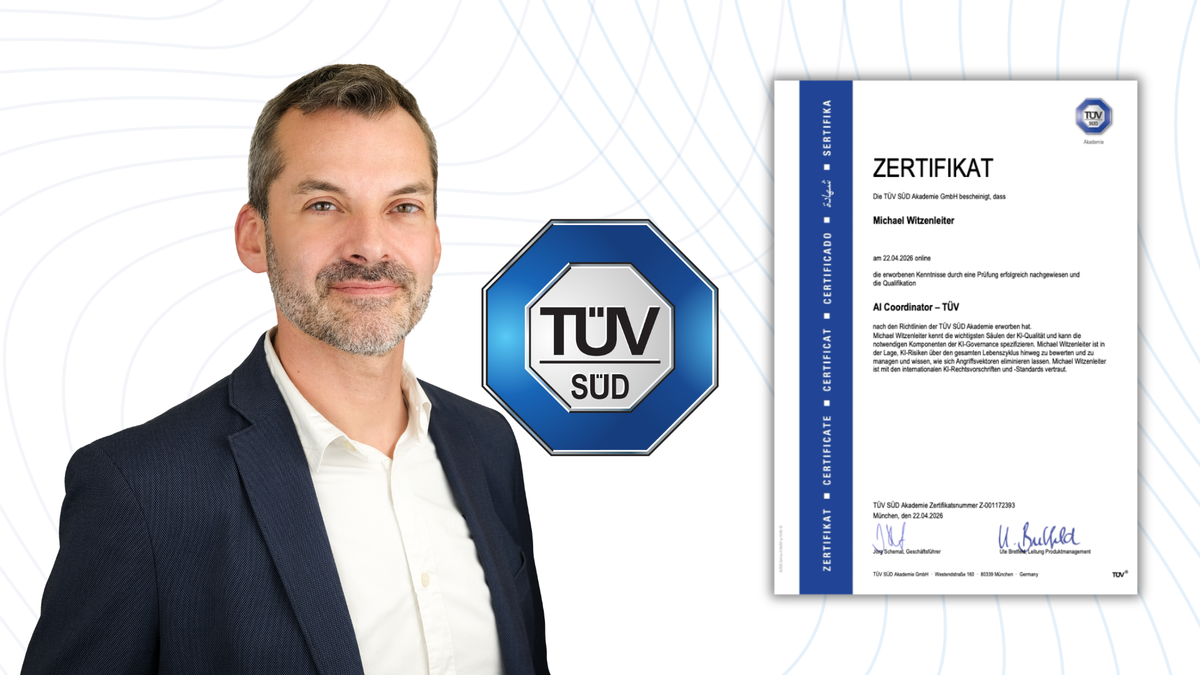
TÜV Süd — AI Coordinator
Michael Witzenleiter | CEO
The TÜV Süd Academy training is based on the AI Quality Framework (AIQ) — a methodology that takes an integrated view of organization, AI system and processes. Mandatory examination covering the entire EU AI Act, Annex III high-risk systems, GPAI models under Art. 51–56 and conformity assessment under Annexes VI and VII.
DEKRA — AI Officer (certified)
Jean-Luc Winkler | CTO
A recognized German qualification for the role under Art. 4 of the EU AI Act. Content: the EU AI Act legal framework and its interface with the GDPR, risk management according to ISO 31000, technical documentation under Annex IV, transparency and labeling obligations under Art. 13 and 50 of the EU AI Act, incident management under Art. 73.
Start now!
The initial consultation captures your specific needs: industry, number of employees, known AI applications, regulatory drivers. The result is an honest indication — including an answer to the question of whether an external AI Officer is the right lever or whether a different step makes more sense.